How Accurate Is Your 3D Laser Scanner? The 4 Precision Metrics That Actually Matter
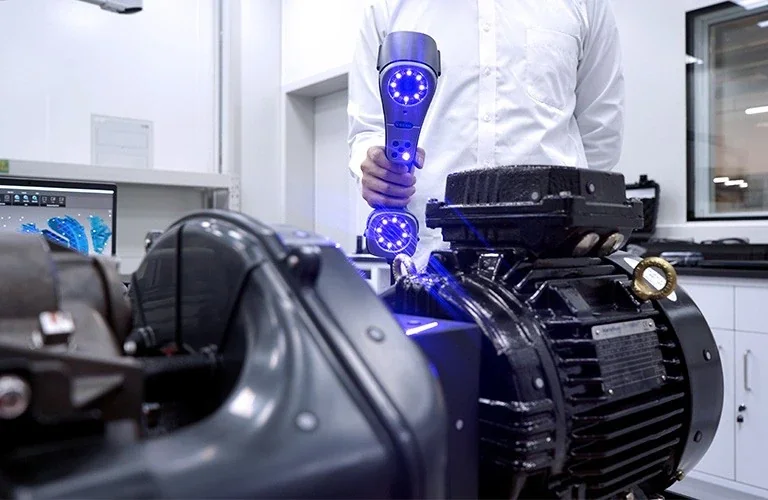
If you've ever watched a 3D laser scanner sweep across a car body or a centuries-old artefact and thought “but how do I know it's measuring correctly?” — you're asking exactly the right question.
A 3D scanner is only as useful as it is accurate. And accuracy, it turns out, is far more nuanced than a single number on a spec sheet. The international standard ISO 10360-13:2021 defines a rigorous framework for evaluating scanner performance.
1. Max Accuracy — How Accurately Can It Measure an Object's Dimensions?
This is the most fundamental test: scan a precision reference sphere and compare the measured diameter against its nominal value. A smaller value means readings closer to ground truth and a more reliable baseline for quality control.
2. Volumetric Accuracy — How Precisely Can It Measure Distances in Space?
Volumetric accuracy shows whether a scanner maintains geometric accuracy across its entire working volume. When scanning aircraft fuselages, automotive body panels or large assemblies, points at opposite edges must still align accurately.
3. Sphericity — Can It Capture the True Shape of a Surface?
Sphericity measures how faithfully a scanner captures shape, not just size. It distinguishes surfaces that have the same best-fit diameter but different real geometries.
4. Flatness — Can It Tell You If a Surface Is Truly Flat?
Flatness captures surface variation from fine-scale ripples to end-to-end warping. The lower the value, the more accurately the data reflects the true condition of functional surfaces.